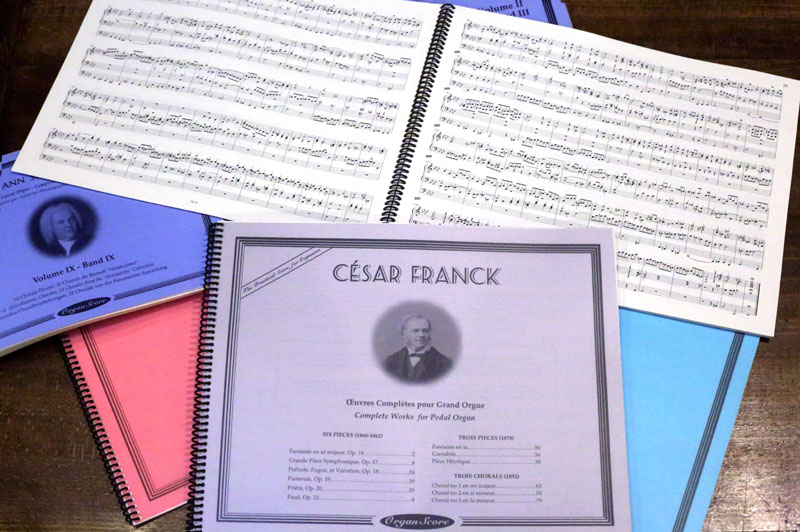

Organ Scores whith Page Turns eliminated
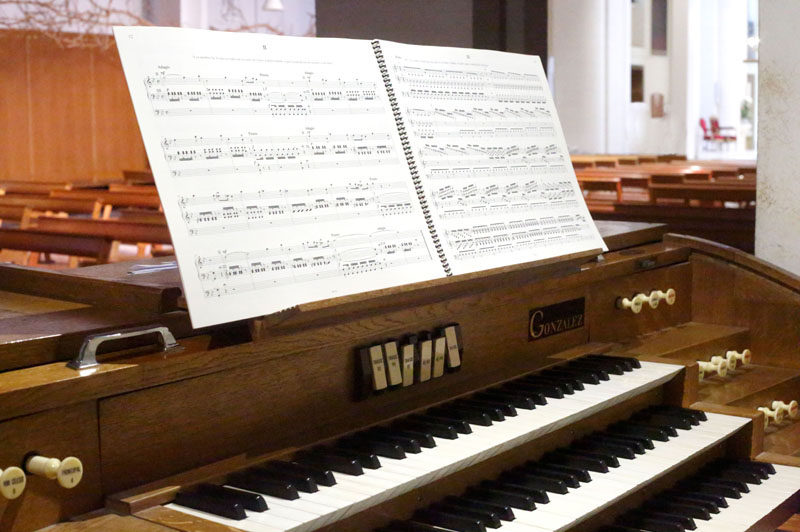
If you are an organist, you almost certainly play with the score in front of you—either because the music is not fully memorised, or because the stress of public performance, often compounded by an uncomfortable console, can lead to momentary lapses. This is precisely why organists need scores in which page-turning problems are eliminated.
The problem with conventional organ scores
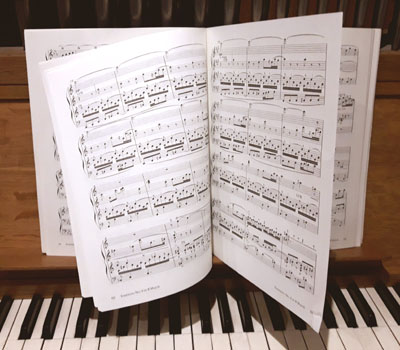
Traditional printed organ editions usually require multiple page turns within a single piece. Binding is another recurring issue: how often have you struggled to keep a page from falling back immediately after turning it?
Digital scores displayed on tablets or computers may seem like an alternative. While such devices have certain advantages, they fail to provide a fully satisfactory solution:
- both hands and feet are engaged, leaving no freedom to operate a page-turning device;
- electronic equipment must be installed at the console and remain operational (battery, software, stability);
- operating systems can fail, compromising absolute reliability;
- digital screens still do not offer the global overview, resolution and visual comfort of a large printed score.
How the page-turning problem is solved
As an organist myself, I came to a simple conclusion: increase the page size so that page turns can be eliminated as far as possible. Using a larger format, I discovered that a very large number of organ pieces could be laid out on two facing pages, with no page turn at all. For longer works, it was always possible to choose a page-turn location where one hand is momentarily free, making the turn effortless.
Many organists know the ritual all too well: taping photocopies together—a time-consuming practice that often results in reduced note size and unnecessary eye strain.
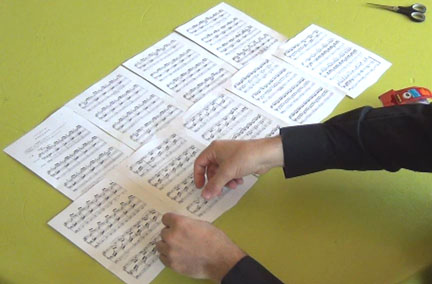
Once this idea had taken shape, I applied it for several years to editions prepared for my own use. It gradually became clear that the principle could be applied successfully to almost the entire organ repertoire—indeed, I have yet to encounter a piece for which no viable solution exists. This led me to create complete volumes devoted to the core organ repertoire and to build a collection designed systematically to solve the page-turn problem.
Some particularly long works required careful thought in order to reconcile optimal page turns with excellent readability. Through multiple trials and feedback from fellow organists accustomed to public performance, an optimal solution was always achieved.
Applied first to the organ works of J. S. Bach, then to those of Buxtehude, Mendelssohn and others, this approach has proved to be the most effective way to eliminate page-turning difficulties altogether.
The result
- Most organ pieces fit on two pages only — no page turns while playing.
- When more pages are required, page turns are easy and well placed.
To learn more about the OrganScore concept, watch the video presentation and discover how large-format scores transform the organist’s playing experience.
Standard music size for optimal readability
When photocopies are taped together, the music is almost always reduced to fit a limited surface. OrganScore deliberately avoids this compromise.
The musical text remains fully readable, comparable to high-quality organ or piano editions, with a staff height of approximately 6.5 mm. This is made possible by the large page format: a moderate increase in page dimensions results in a much larger usable surface. In fact, an OrganScore page offers roughly twice the surface area of a conventional organ edition.
In rare cases where page turns remain difficult, additional solutions are applied—without any loss of readability, and often with improved clarity:
- removal of unnecessary empty staves;
- occasional use of a single staff when the musical texture allows it.
For further details on readability (fonts, staff height, spacing, line thickness and layout principles), please consult the dedicated article.
The OrganScore panoramic page format
The OrganScore® 375 × 297 mm panoramic format is central to solving the page-turn problem. Page-turn locations are optimised for every piece in every volume.
Beyond performance, this layout offers a major advantage during the learning process. Consider the stages involved in mastering an organ work:
- first reading,
- learning short sections (typically one to four bars);
- rehearsing longer passages;
- complete run-throughs;
- revisiting problematic sections;
- partial or full memorisation while retaining visual reference;
- repeated run-throughs to confirm full mastery.
At every stage, the global overview provided by a score without page turns is a decisive benefit. Having used large-format scores for many years, I personally could not return to conventional editions. Live performence videos further illustrate how panoramic scores allow the organist to concentrate entirely on playing.
The OrganScore edition
Solving page-turn issues is only one aspect of the OrganScore philosophy. A high-quality organ edition must also be practical, durable and musically reliable, while covering the repertoire every organist is likely to perform.
A practical tool for organists
- eliminated or effortless page turns
- durable plastic cover
- binding that prevents pages from turning back
- clearly organised table of contents
A high-quality musical edition
- clear, standard-size typography
- thick paper with excellent opacity
- optimal contrast on ivory-coloured paper
- Reliable musical texts
- rigorous editorial work
Organ scores for the great repertoire
One of the primary aims of the OrganScore collection is to cover the core organ repertoire. The initial releases include complete organ works by essential composers such as Johann Sebatian Bach, Dietrich Buxtehude, César Franck, Johannes Brahms, Felix Mendelssohn, Charles-Marie Widor, Louis Vierne, Camille Saint-Saëns.
The collection continues to expand and will be enriched with new volumes on a regular basis.